
“Who Killed Chancho?”
A Farcical Tragedy
New reader? Start From The First Story Here
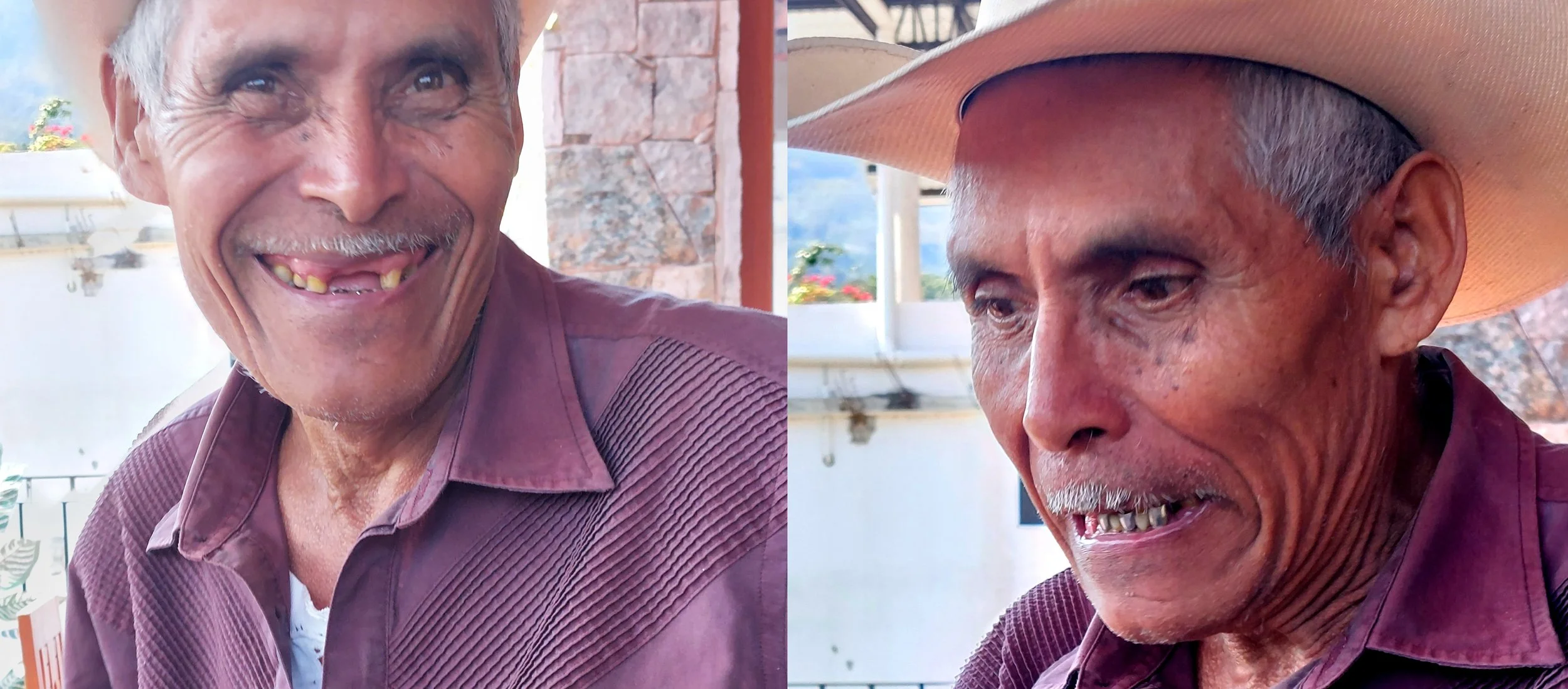
The man the myth.
BLOG POST #024 - The Farcical Tragedy of "Who Killed Chancho?"
How I learned to ride a motorcycle, speak Spanish and not die. Riding solo in search of adventure from Detroit to Argentina.
Missing two front teeth with a gold grill on his lower choppers gave him a great range of expression. His smile looked dopey yet his scowl looked gangster.
Just because a man was humble and old, doesn't mean his life was worth any less. After he was gone, the small town of Xilitla ("heel-HEET-lah") in central Mexico would never feel the same.
Years later the question still haunted me.
"Who killed Chancho?"
My adventure-travel-buddy Rusty joined me in Xilitla to soak up the local scene, take photos of the town, and chill out for a few days. That is when we met Chancho.
The freshly yarn-spun tragedy I shall detail here involves a complex mix of cultural nuances, rural poverty, inside jokes, and shyttt we just made up.
To be honest, we don't know what happened to Chancho. I'm sure he's just fine and right where we left him. Still, every good fable needs a martyr and I'm not changing the title now.
Death comes in many forms. Sometimes it is an unavoidable accident or genetic disease that plucks a soul from this mortal world. Other times it is the result of the un-forced error of poor life choices or shady dealings.
On this range between bad luck and stupidity, I wonder where I land on the scale. I suppose we'll have to wait until I actually die to find out.
I'm reminded of the conversation I had with a friend years ago. She texted me after one of my own (many) self-inflicted brushes with death. While traveling solo in West Africa I walked face-first into a wasp nest. Twenty or thirty stings on the head and brain-stem put me into severe anaphylactic shock and I was on the ground within five minutes. Three days later I was still in a fog as I left the hospital, when she reached out.
"Hey, are you ok? Like, for real - ok?" She asked.
"Yes. Duly traumatized. Freaked out & bawling for no reason at times, still in pain, fuzzy-headed, but just fine overall," I replied.
"Oh, right - that totally sounds 'just fine.' lol" She texted with a bit of sarcasm.
"Well you know I am un-killable, so I was never that worried," I reminded her. "Actually, no. I was pretty sure I was going to die. But here I am!"
"Jesus. Ok. So what is next? Are you flying back?"
"No. Pfft." My head jerked back with a big-belly-laugh as I typed. "Is that what normal people do?"
"I don't know, I just thought you probably hated that place now and needed to get home." She said.
"Quite the opposite." I asserted.
"A pilot never sets out trying to crash the plane, but it's really good to know that his parachute works. I feel emboldened, like the safety systems kicked in and did their job. The bushman I was traveling with called for help, a whole village of strangers came out to take care of me, and my friend drove me to a clinic where his MD colleague took over. Fifteen strangers passed my unconscious body hand-over-hand to save my life. I am happy, grateful, and love this country all the more now."
"Ha. I can't believe you're feeling jolly after such a major accident. Only you, buddy."
"Meh. It is in the past. Refer to above...un-killable." I wrote.
"You’re the only person I know who almost dies every week in some really interesting way." She mused.
"Yeah, but when it does finally happen — it’s going to be spectacular. lol"
As a professional calculated risk taker myself, I know what adventurous people are like. Back in Mexico, Chancho did not seem like a daredevil. My guess is that he did not deserve to die. Alas, sometimes there are no answers.
Again I wonder, "Who killed Chancho?"
There's always a restaurant in some far-flung corner of the world where a Frenchman or Aussie runs the bar. Xilitla is one of those enchanting places that foreign tourists get "stuck" like this and never leave. The thought of staying forever had crossed my mind a few times as well.
The surrounding region has a rich diversity of colonial cities, cloud forests, and parakeet caves. The Sierra Madre Oriental mountains loom large in the distance and send along whatever weather they see fit. Xilitla itself is nestled into the hillside of a rainforest. It sits at the crossroads of tourism and modest rural Mexican life, including a healthy population of indigenous Huastec people.
This little pueblo fits my style "to a tittle", with its street markets, great food, modern amenities and nearby jungle on all sides. Art shops and restaurants huddle around the town square where children in bright school uniforms flood the streets each afternoon. Music blares during festivals and holidays, as traditional line-dancers jump around in rows two by two.
Mexico. Line Dancing. Xilitla. Adventure Travel.
While people-watching for hours at a time, I became obsessed with the old men who played music for restaurant patrons. This was a local twist on the classic Mariachi hustle. Once in a while tourists offer tips to request a song or two, but mostly these singers get paid because you want them to shut up and go away.
Stealthy old-timers sneak into patios or open air cafes where they magically appear in the corner with an abrupt burst of sad melody. It is un-invited and awkward by design. Customers often ignore the noise and carry on eating.
My favorite part is when it becomes a contest of wills. The old man doesn't want to be ignored, so he steps closer to the table. The people continue talking as if he's not there. He belts out his song louder. They stretch necks across the table and huddle close to hear each other. Finally someone cracks. The musician gives up on his own or else the diners hand him some coins to move on.
The words they say are, "Muchas gracias," but the words they mean are, "Please f**k off now."
The instrument of choice among the geriatric buskers in this part of Mexico appears to be a five stringed mini guitar called a Jarana Huasteca (ha-RANN-ah WAAS-tekka). It has a special connection to the area, as part of traditional huapango music. Originating as far back as the 1500s, huapango is a mash up of African, Spanish, and local indigenous sounds. When part of a quartet, the Jarana is spanked with percussive, rapid strokes, serving as a rhythm section keeping the beat in the absence of drums. However, I have only seen it played solo.
The songs are melancholy tales of despair that always start with "Mi corazón" (my heart). Rusty and I chuckle, as we make up our own titles that fit the genre.
"Mi corazón tan triste." (My heart is so sad.)
"Mi corazón destruido, mi esposa muerta." (My broken heart, my dead wife.)
"En el corazón de mi corazón." (In the heart of my heart.)
Then the ever popular, "Mi corazón, mi corazón, ¡mi corazón!" (My heart, my heart, my heart.)
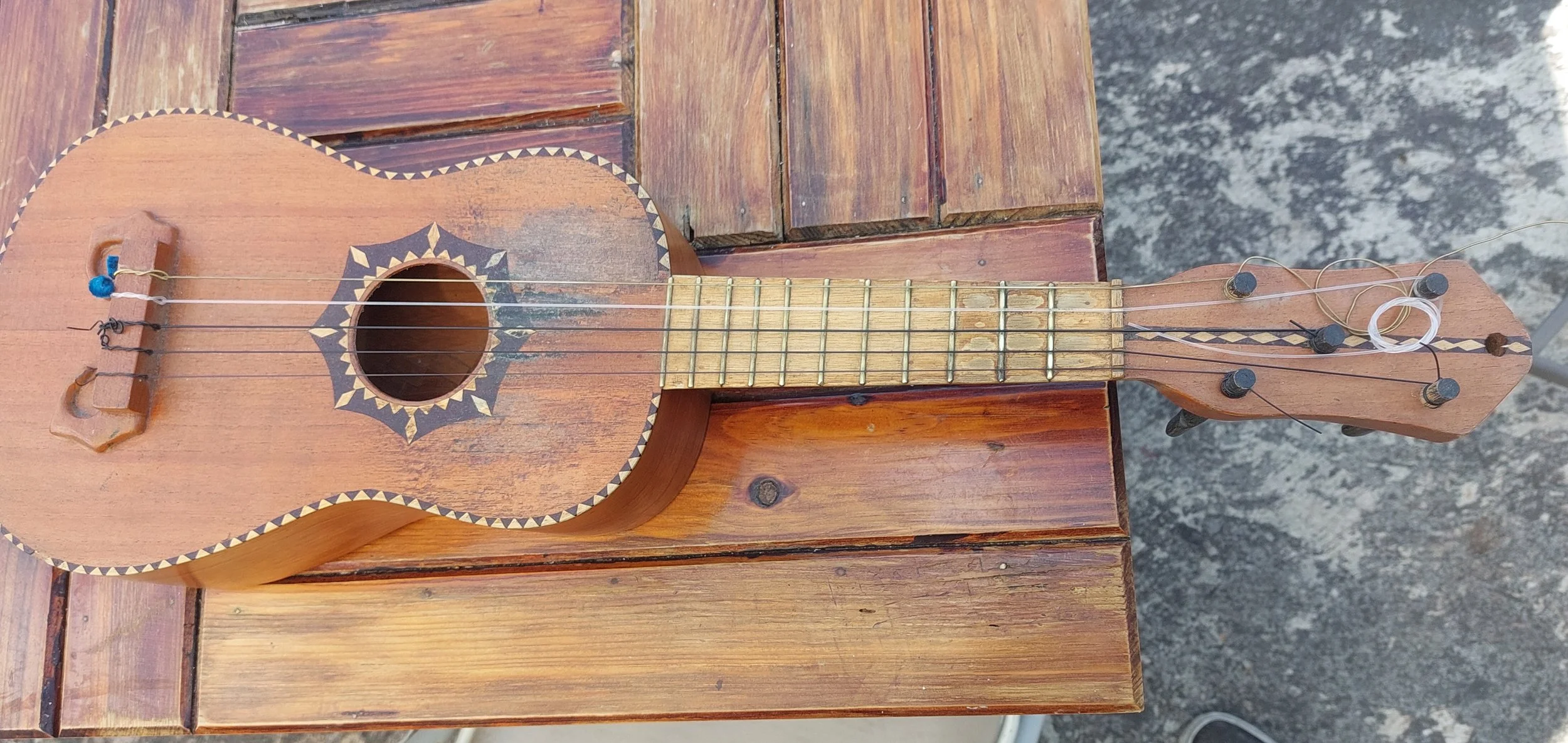
Traditional Jarana Huasteca guitar from the region.
We walked around town visiting music shops and talking to street performers. The more we hung out with these guys, the more I wanted to learn to play the Jarana guitar myself.
Still heartbroken over my ex-girlfriend "Larry,” (nickname given to her by friends over me talking about her, ha)I was not always thinking straight. Learning to play a cute little guitar and sing ballads in Spanish, seemed like it would boost my romantic street value.
Horrified as soon as it crossed my mind, I thought, "Hot chicks love that shyttt, right?"
With a little throwup in the back of my mouth I realized how creepy and pathetic that sounded. I was still pretty messed up. Everybody is entitled to a little crazy sometimes so I tried not to judge myself too harshly. These mad musings were my way of coping.
Romantic longings aside, I thought the Jarana would be a cool and unique thing to learn.
One afternoon Rusty and I had lunch on a balcony overlooking the jungle. It was a bright, pleasant day with a soft breeze and jungle birds twittering nearby.
As if conjured from the rainforest mist, an old man and his Jarana suddenly materialized behind us. I turned my head ninety degrees and glanced back over my shoulder to nod "hola" as he began strumming, softly crooning out his desperate tale of woe.
Chancho playing us some songs over lunch, before we invited him to sit.
One thing I forgot to say about this classic street shakedown is that the music is often terrible. It is made up of one or two chords with indiscernible lyrics, played by an unenthusiastic farmer who never makes eye contact until asking for money. These are not artists dedicated to their craft, but rather street beggars with a ratty Mexican ukulele. The apathy and lousy consonance add a surreal charm to it all.
This guy looks bored by his own music.
Once he is finished I offer him a few coins and ask if he would like to join us for lunch. Rusty explains that we want to ask questions about the Jarana.
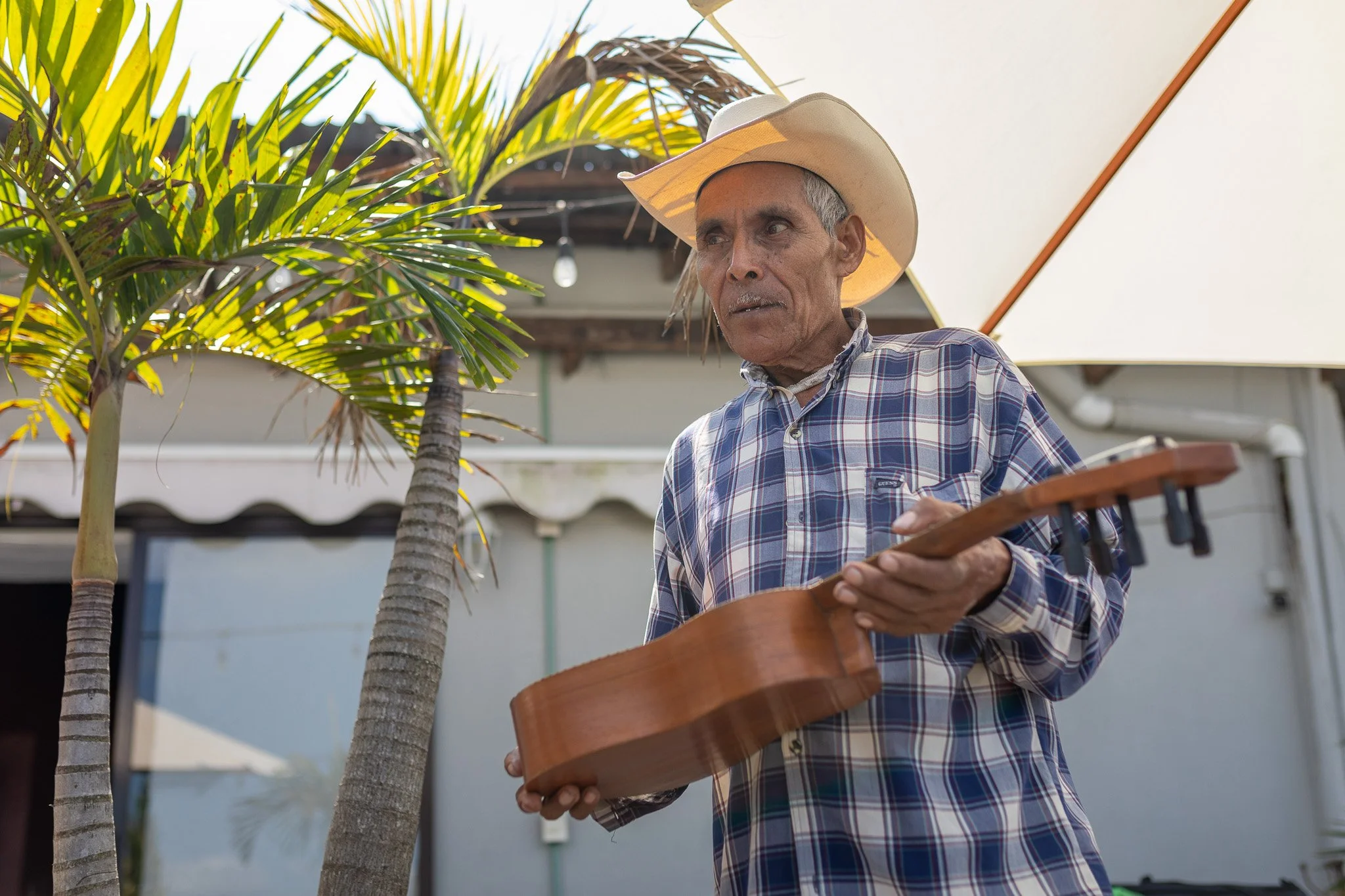
Meeting Señor Unpronounceable for the first time.
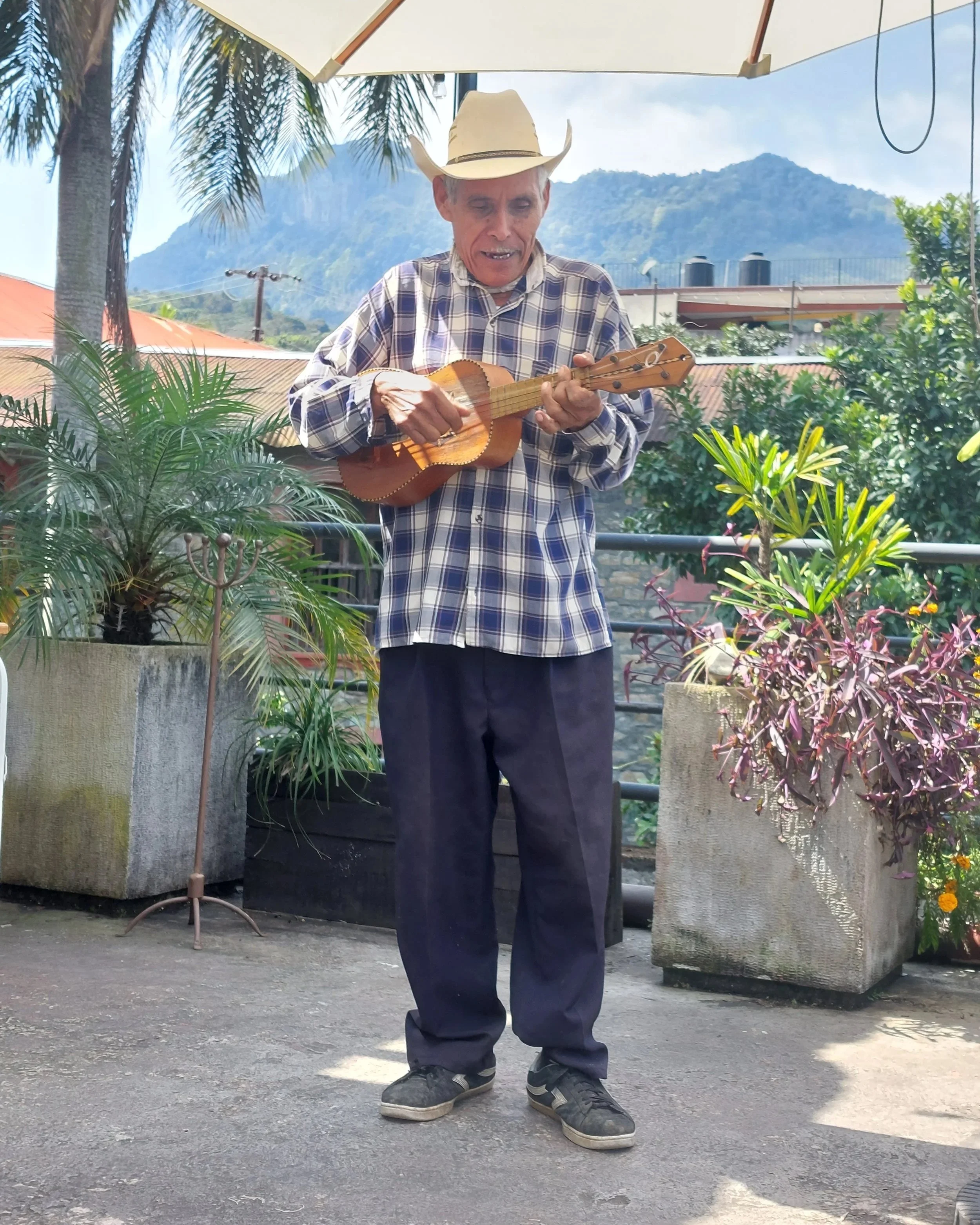
A lunchtime serenade.
The old man looks like he's sixty five, with the spine of a ninety year old. My guess is that the miles were a lot harder than the years on him. His straw woven cowboy hat sits atop a head that seems too big for his skinny body. Deep sockets shade sullen eyes and his wrinkled neck reminds me of a warped old birthday balloon that has been leaking air since the party ended a few weeks ago.
It seems ironic that he doesn't have the money to replace his missing two front teeth, yet he has a gold grill on his lower choppers. This gives him a great range of expression.
His smile looks dopey yet his scowl looks gangster.
We order some sandwiches and beer. The old man takes a chair and we introduce ourselves.
Rusty does most of the talking because his Spanish is so much better than mine. Native born Mexicans are often surprised at his fluency and impeccable accent. His mastery of linguistic nuance and regional slang serves us well. It helps make friends everywhere we go. He speaks with ease and confidence.
However, even Rusty's decades of Spanish fail us when this old man says his name. We can't understand a single syllable of the noise he makes when pronouncing it. After he repeats it three or four times, we are too embarrassed to ask again.
I decide to call him "Chancho."
This lights up a full dashboard of politically incorrect warning signals in my brain. It is dismissive and culturally condescending to re-name somebody because you can't be bothered to learn his "foreign" sounding name - especially when we are the foreigners.
On the other hand, Chancho didn't seem to mind and we found it quite funny.
We never learned a lot more about his life, but from then on we felt a certain gleeful artistic license to invent stories about Chancho. We amused ourselves filling in all the blanks of who he was and the life he had lived, like some private improv comedy show. It was a performance of two, for an audience of the same two. By the end of it all, the details were so badly blurred I couldn't remember the difference between fact and fable. Either way, it made for a good story.
When he was a young man, Chancho made his living as an apprentice stone mason. Colonial era churches needed constant attention, as he honed his skills over the decades. He traveled around the region to work, but never strayed too far from home. He liked to see other places, but big cities made him nervous.
At one point a man offered Chancho a partnership to start their own company and take on big projects. But alas, Chancho was a craftsman, not a businessman. His modest ambition in life was to toil each day and put food on the table. He would form stone into buildings that would stand for centuries, and that was enough for him.
Chancho was a dedicated provider for his wife, señora Teresa. They had been together since they were childhood sweethearts. Back then, her hair was jet black and he played futbol in the dusty flat clearing across from her house. She would peek at him through gaps in the wooden slats of the walls, with big curious eyes filled of romance yet to come. She was very shy, but Chancho thought she was the prettiest girl in the village.
Since then, Chancho and señora Teresa got married, raised a family and built a home together. Their son and two daughters grew up to have children of their own. Last year, señora Teresa even got to say hello to a brand new great-grand baby.
Chancho lived a good life and served the lord, working until his back could no longer lift slabs of stone and his hand could no longer steady the mallet.
These days señora Teresa mostly just sat quietly in her favorite wicker chair on the front porch. After a lifetime together, there wasn't a lot left to say. Chancho watched the sunset with his hand on her armrest, as she did her embroidery. Rotten baseboards made the porch creak, and the chair was propped up with a tree stump under the broken leg. It was a simple way of living.
Chancho had elotes at the local market on Sundays after church. He liked to buy gardenias for señora Teresa to put in her hair. They didn't need much, but times were hard for a broken old mason. The world had passed him by and there wasn't any money to spare. The price of corn had gone up and the flowers were far too fancy for his budget.
One day, good fortune fell into Chancho's lap. The town priest, Padre Esteban played music for the congregation at The Church of El Milagro Inútil. However, he also did some side gigs to make a little extra walking-around queso. The good Padre had some bad habits, playing for the local Cat-Juggling cartels, who were on the rise in the region. They expanded their wealth, power, and mildly rough treatment of family pets across the land, in what was referred to as, "A great ugliness."
Chancho watched YouTube videos of this horror and wondered, "Could there be a god that would let this happen?"
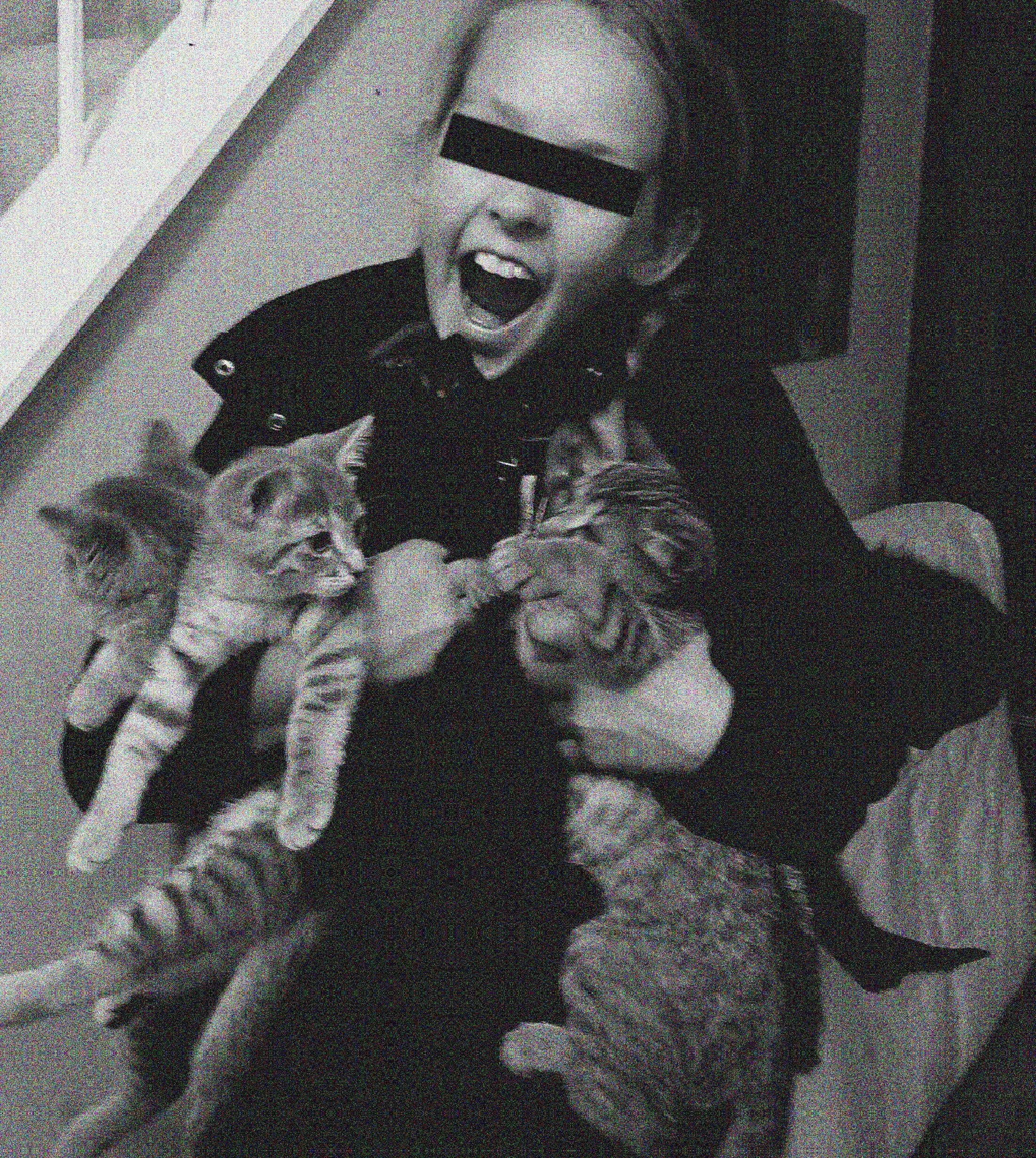
It was said that La Lanzadora Lydia could do five at a time before the age of thirteen.
Padre Esteban was not proud of his participation in these events. But they paid cash on the spot in new, unmarked bills that skeezas in the strip clubs preferred over the shasty singles that came out of the church donation box.
Sadly, Padre Esteban was killed in the crossfire during a raid on one of these underground cat-juggling rings. When Chancho heard the news he realized that it was his lucky day. The Padre had left his best Jarana at Chancho's house a few nights earlier when he was too shyyytfaced to walk home.
With his beloved instrument, newly liberated from the corpse of a holy man who had been cut down in a hail of Guardia Nacional gunfire, Chancho's wonderful musical career was born.
Talking over lunch I asked Chancho all about which songs he plays, where to get sheet music, and how hard it was to learn. Eventually I dialed in on the real topic, which was that I wanted to buy his Jarana. Having shopped around at the local music stores, I had an estimate of how much they cost new. However, I'd much prefer a well-worn authentic guitar, like the one Chancho had. He said that he needed this one because it is the only way he can earn money. Has a spare one at home, so we negotiated a price and agreed to meet the next day.
After lunch, Rusty and I headed towards the covered market. Years ago, some shopkeeper must have set up four walls and a roof out of blue tarp. One neighbor added on, and then two more. Over time, more people built on one by one until this permanent tent city spread over two city blocks, forming a maze of dark alleys lined with merchants of every kind.
Mexican Market. Mexico. Shopping. Xilitla.
We explored different areas. There was a section for electrical adaptors and toasters, as well as rows of butcher shops with raw meats hanging on a hook, to an endless line of clothing stores with cheap shoes and knock-off Barcelona soccer shirts.
After dark, the town took on a strange aura. Rusty quipped that maybe everyone here was a vampire, but that there was a ban on killing and eating foreigners. His theory would explain a lot of things. We had dinner at a place that tried their best to scare us away. They said it was almost too late to serve, but still seated two other tables after us. They didn't bring our food until the place was utterly cleared out ninety minutes later.
By the time we left the streets were empty. The only shop open was selling beans from Michigan. That's our home state! This is surreal, being that we live in a very cold climate.
Rusty says, "Shouldn't Mexico be selling produce to us, instead of the other way around?"
"Yes! Especially beans," I replied.
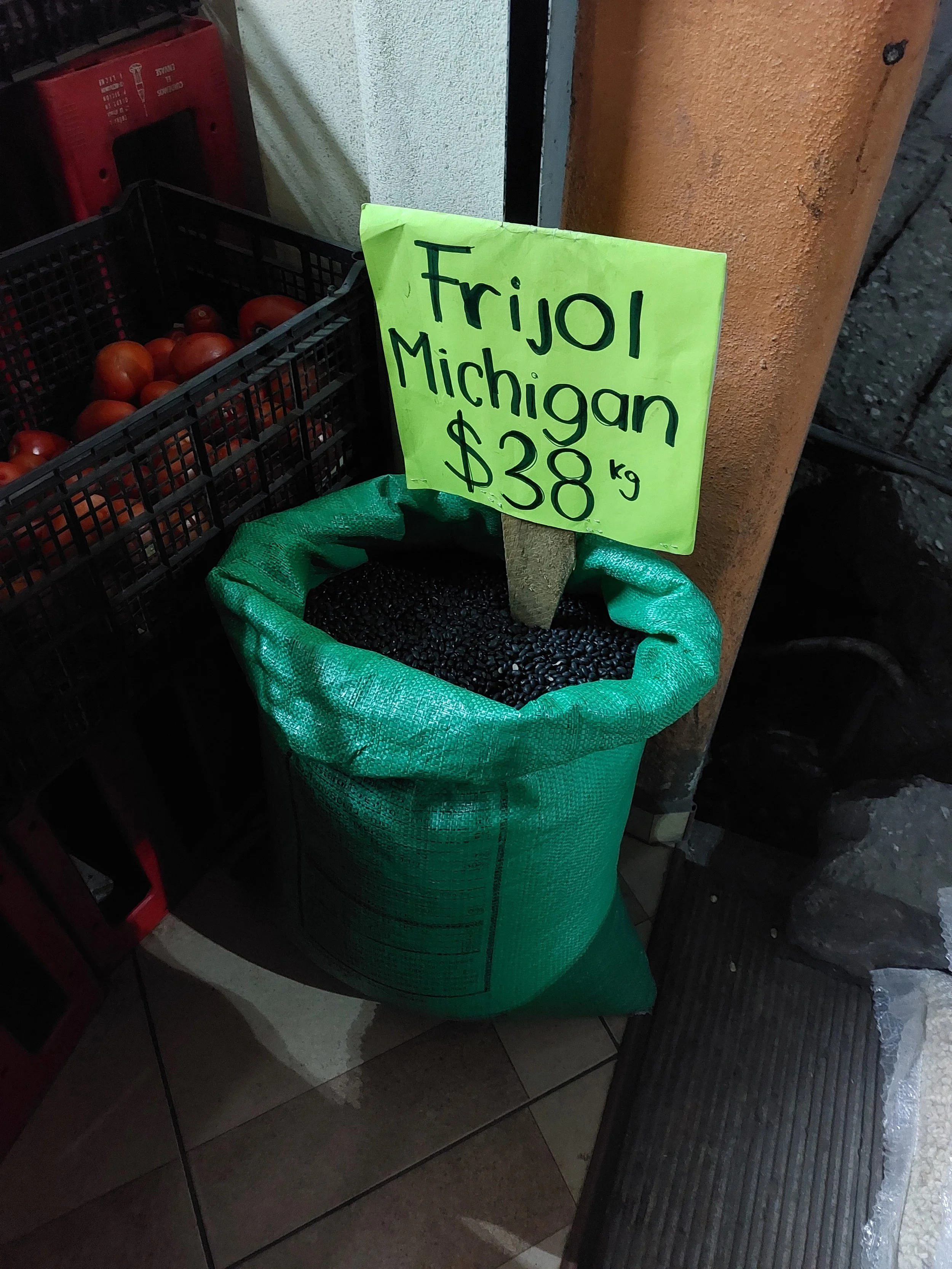
Beans from back home. You stumble onto the weirdest things when you travel.
We found one place open where we could get a beer. As another reminder from whence we come, they are blaring NFL football on eight or ten TVs around the bar. A one-man rock band showed up at halftime. When he realized he would have to wait till the end of the game, he got very huffy as he set up his gear. When the TVs went off, people stood up to leave and he cursed them out as they walked away. Obviously he was an old pro at connecting with his crowd. Apparently we were invisible because he didn't glance at us. It seemed like people didn't want to interact with Rusty and me, and only said the minimum words necessary to us. We kept getting change, all in change. As we left for home, I had a pocket full of coins that weighed four pounds.
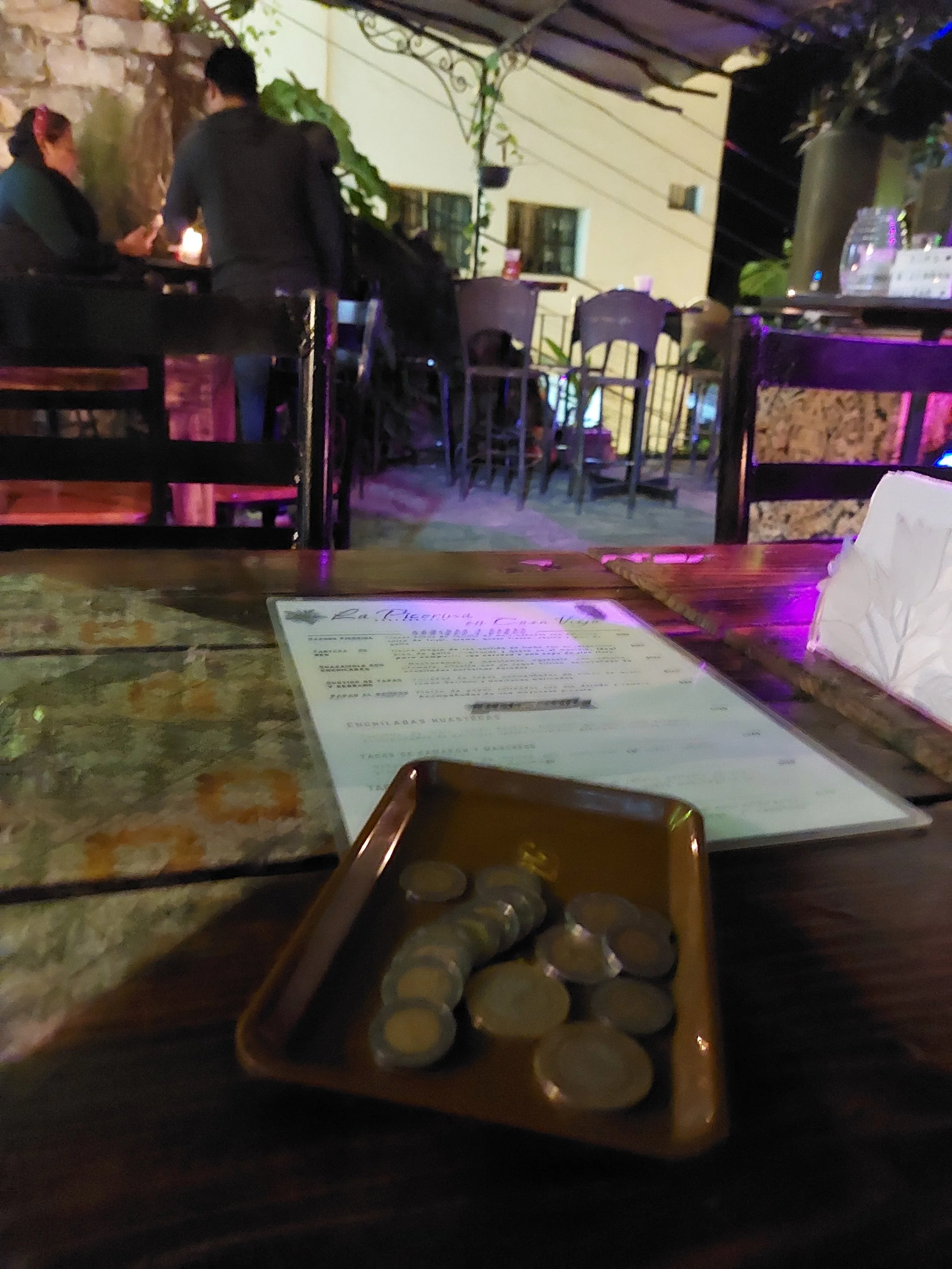
Was there a coin-money laundering cartel in this town we didn't know about?
Walking up on a puddle of dark fluid on the road, we get an uneasy feeling. When someone pees on the ground, it splatters nicely into a pretty fireworks pattern. If someone pukes there are chunks. But when someone is pinned to the ground by the face while the blood is sucked out of their neck until their skin pulls tight like microwavable plastic-wrap stretched over a bony corpse - it leaves a completely different stain on the ground. We don't ask questions and move on.
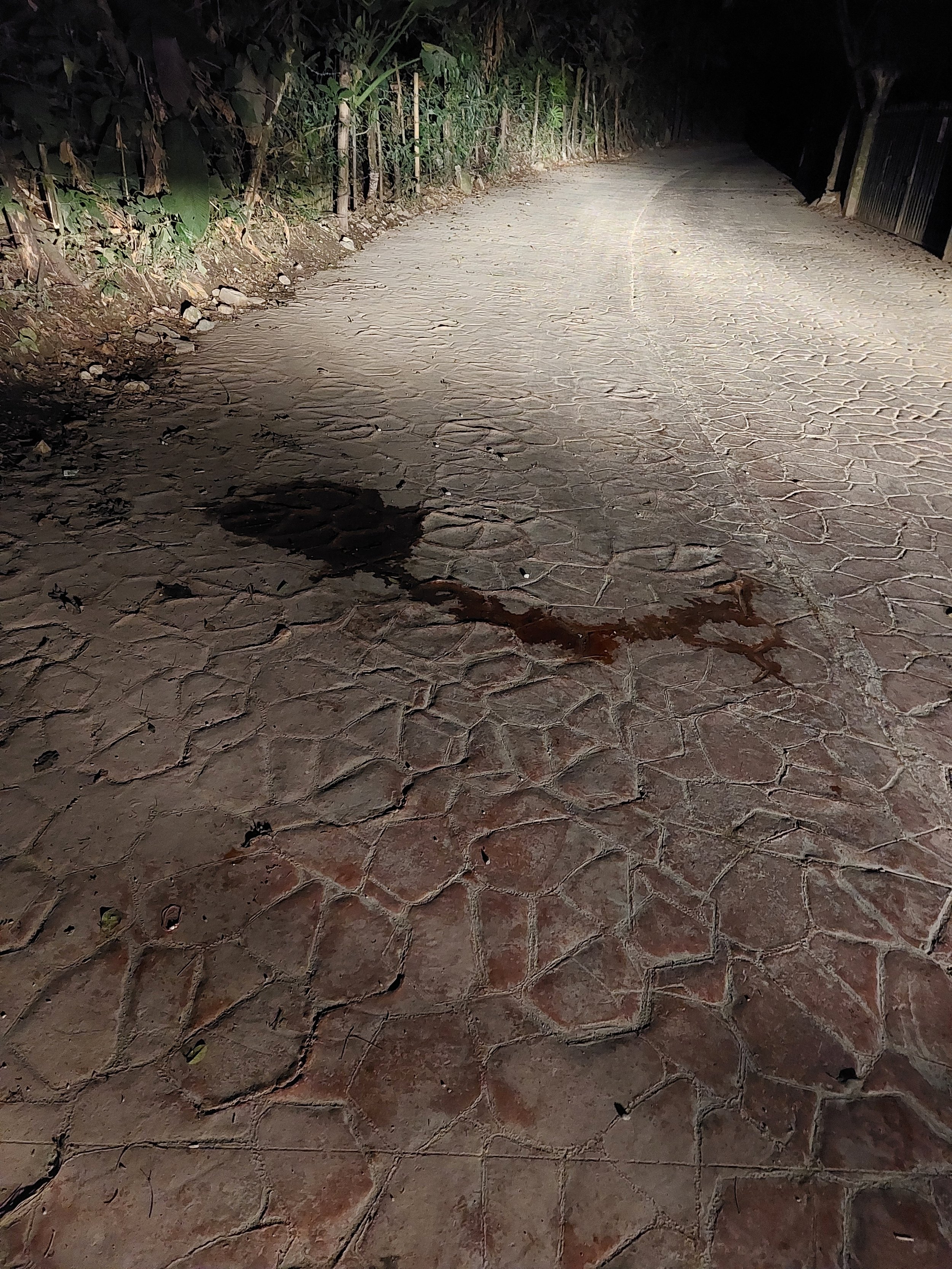
The un-dead must have been having a little snack a few minutes prior.
With so much weirdness around, it definitely seemed like a vampire town.
Or maybe we're just loud gringo a-holes and no one likes us. It's hard to tell when we've been drinking.
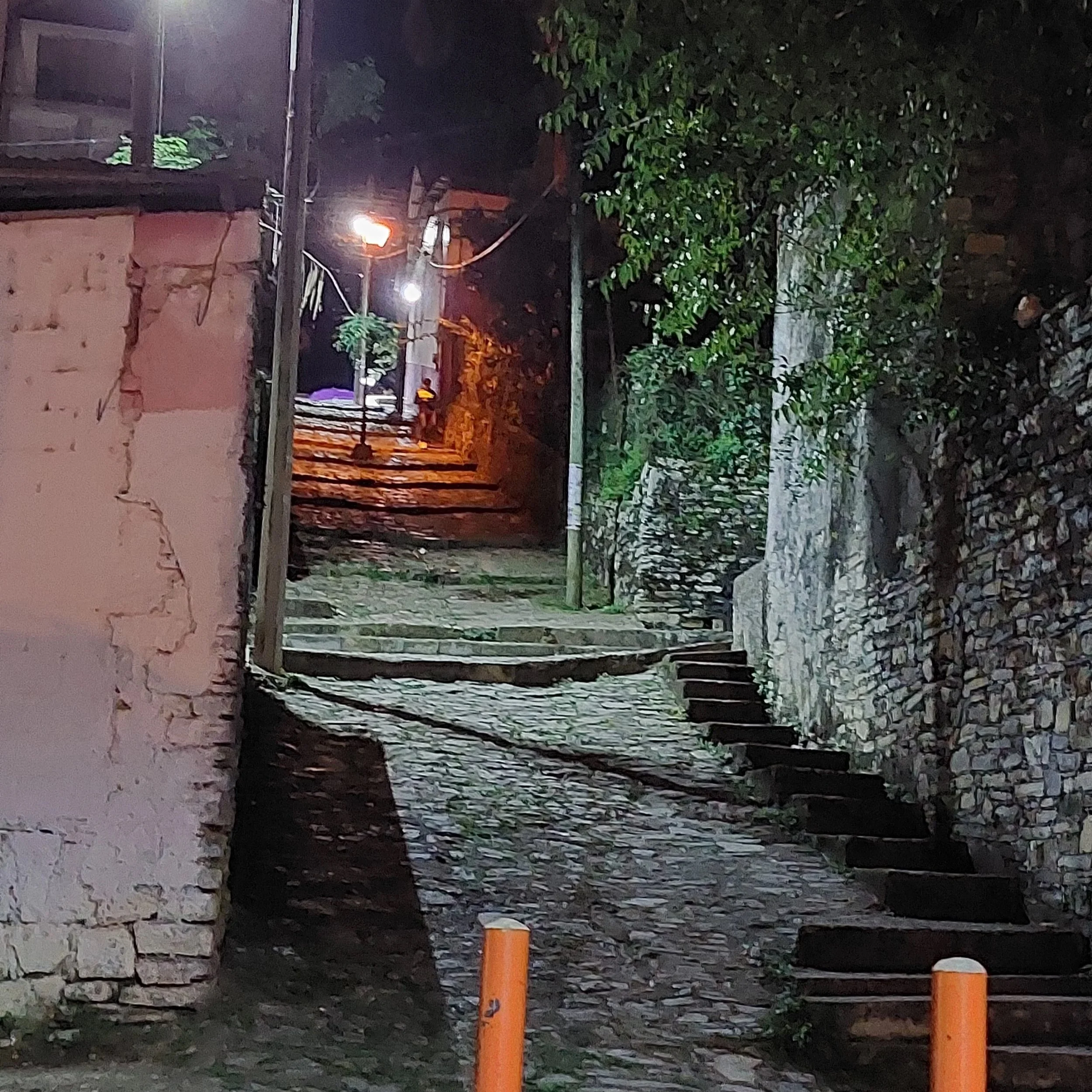
One of the hills I had to navigate there the first trip. On my Kawasaki KLR 650.
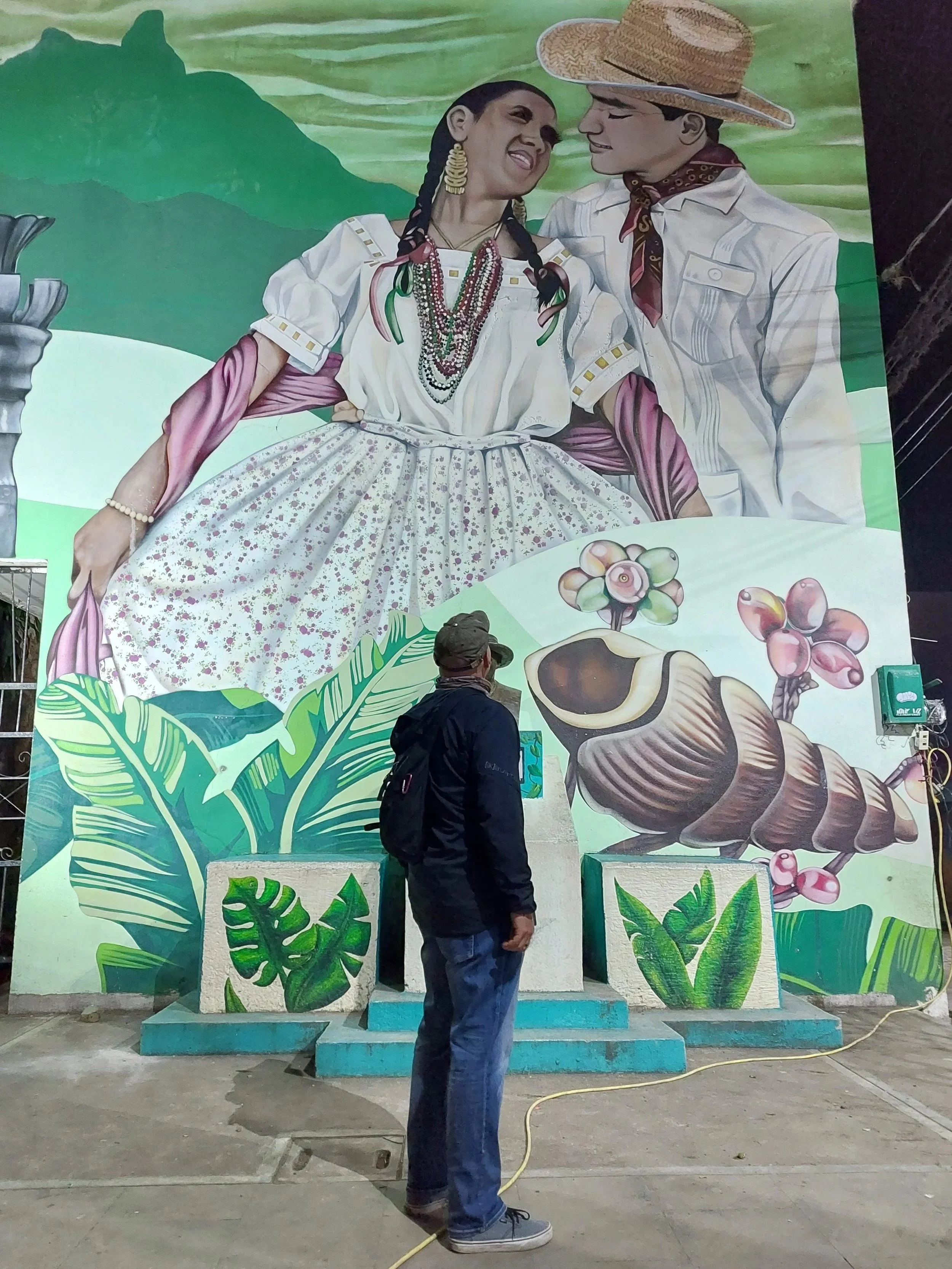
Loving kiss, or is he going for the throat there?
The next morning I woke up with a spring in my step, looking forward to the big purchase of my little guitar. One thing that I appreciate about being a man is that, with only the slightest nudge from a friend I can always snap back to being a dumbass thirteen year old. Rusty and I roam the town with a giddy wanderlust, seeing humor in everything around.
Do a little fun-dance over looking Xilitla, Mexico after buying Chancho’s guitar.
A slightly drunken man-child dance.
We went on a two-bit shopping spree like neighborhood boys blowing their entire weeks' allowance on useless trinkets. We bought a bandana, Pinguinos cup cakes, and a lighter.
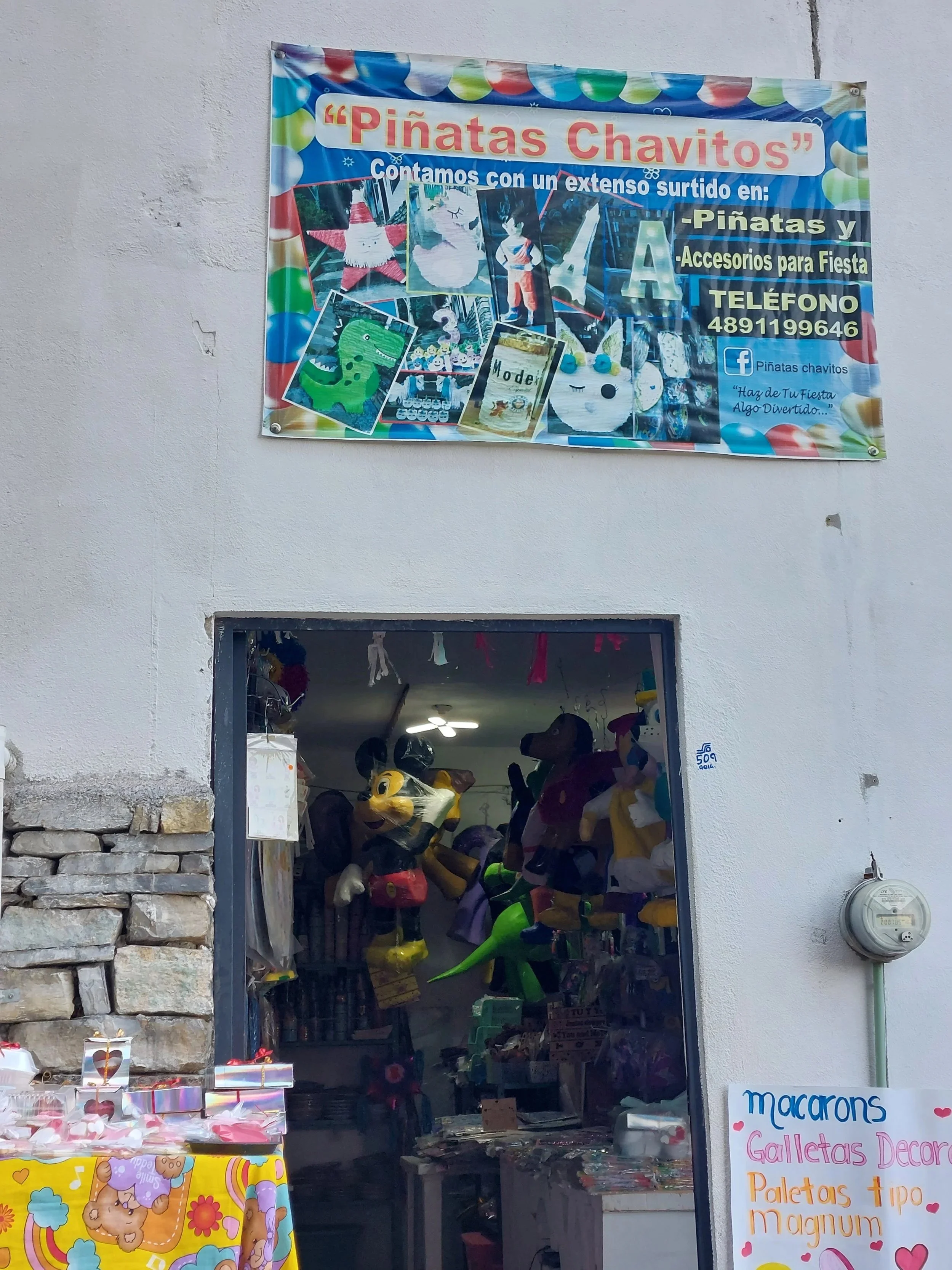
Gotta love a piñata store
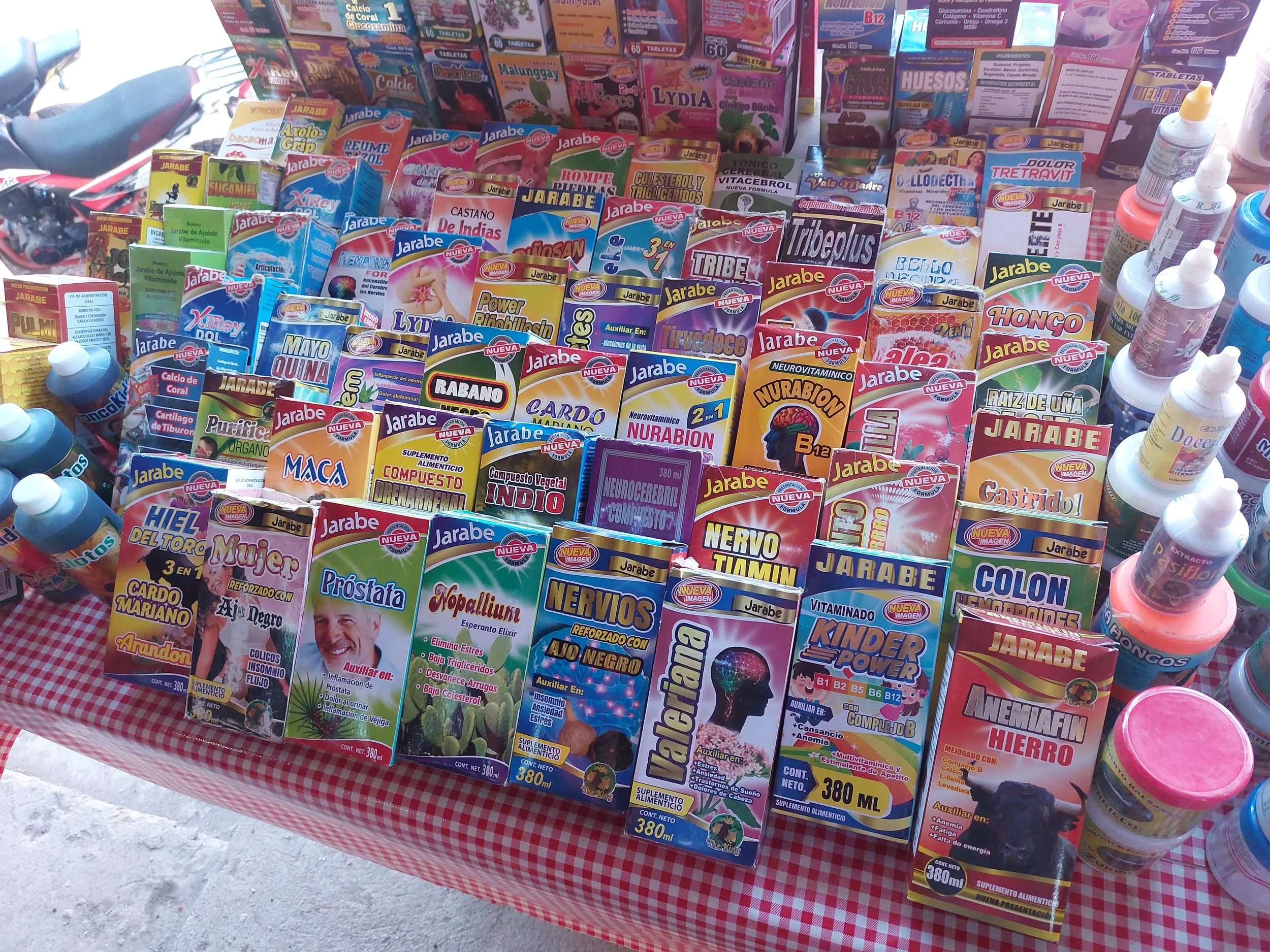
Heart meds to tummy pills to weenie boosters.
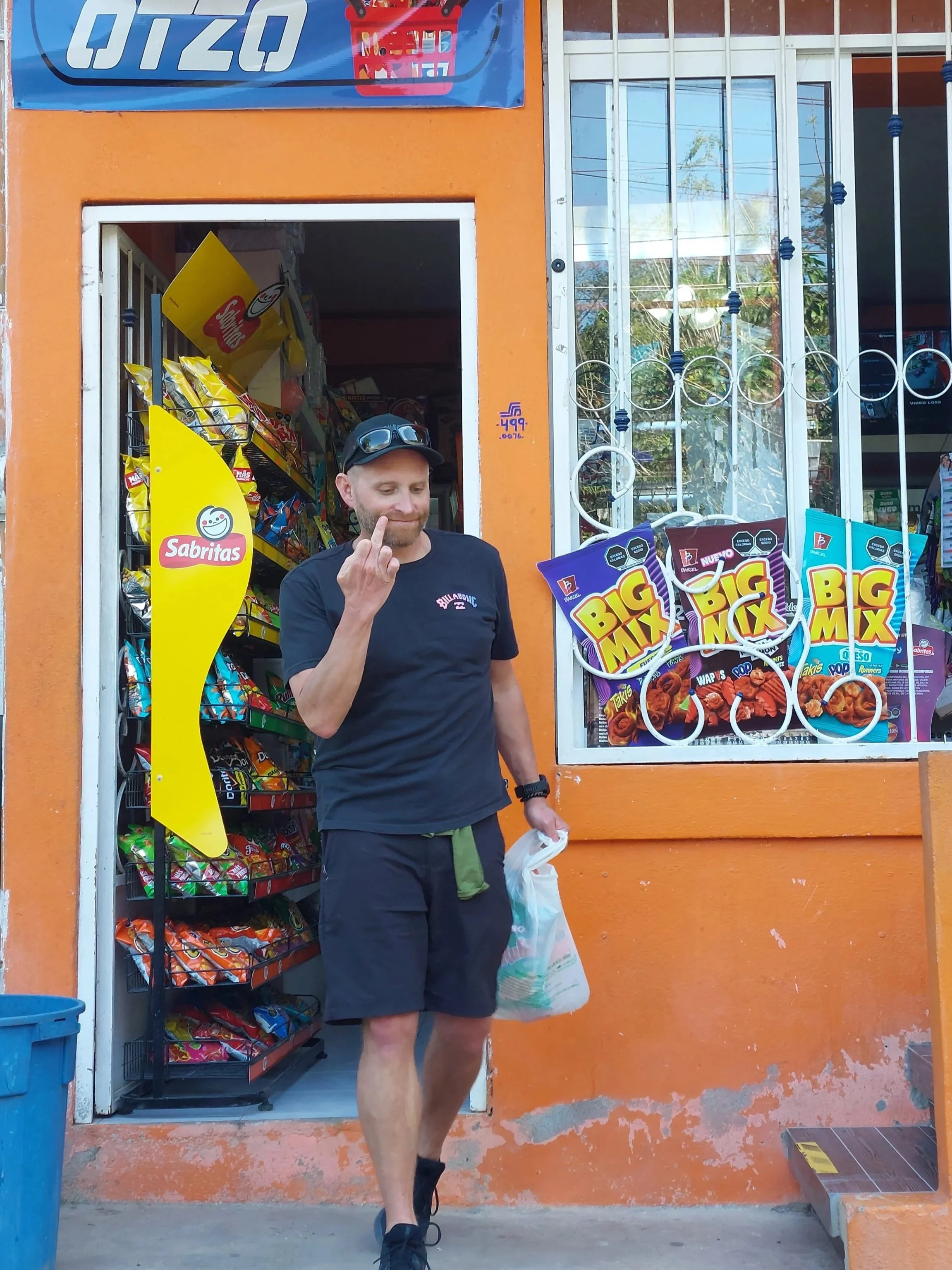
Rusty is camera shy, but his finger is quite outgoing.
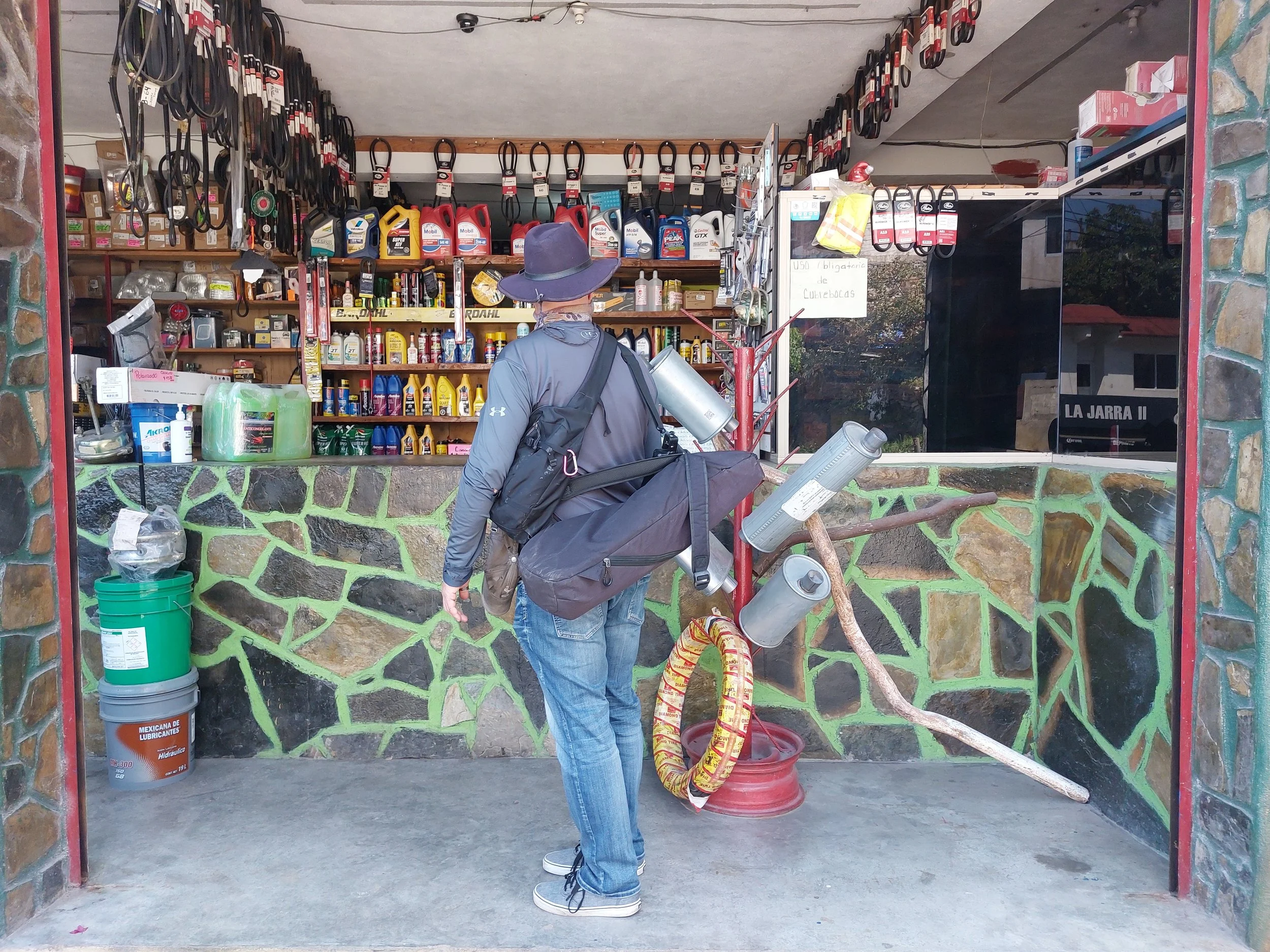
I just "feel" like I'm going to need a Honda Civic muffler for some reason that turns out to be completely logical later.
Restraining every instinct, I chose to NOT buy a lovely framed photo showing off the bloody corpse of General Francisco "Pancho" Villa. The caption valiantly celebrates the glory of his death.
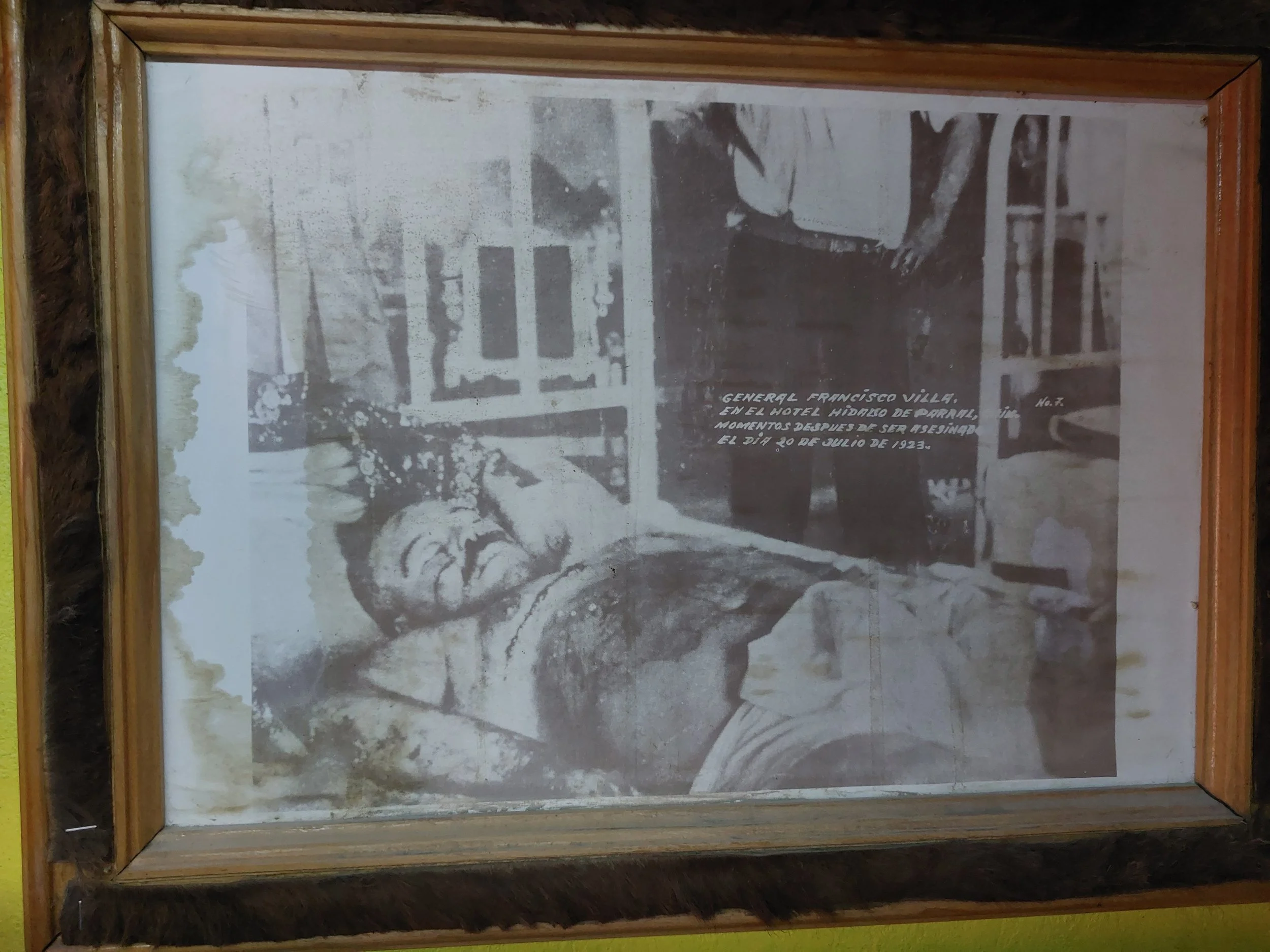
Pancho Villa, not looking well.
Then I hit the jackpot of idiot-man adolescent gold, when I found a store selling a switchblade in the shape of an assault rifle. "I'll take two!", I said, of course.
A switchblade we found in the Xilitla, Mexico market. Worth every penny.
Bringing a gun-knife to a regular knife fight...the other guy probably chickens out.
Rusty declared that we should start a band. I'll be the roadie and play the Jarana. He can do lead vocals and play the cowbell.
We bought a cowbell.
As afternoon rolled around, we waited anxiously at the rendezvous point for Chancho to bring my new-used Jarana. Once he arrived at the restaurant, beers and lunch were ordered just like the day before.
It turned out that Chancho didn't have a second Jarana like he had thought. His back-up piece was a busted old full-sized guitar that was missing parts. He didn't know how to play it anyway. He decided to sell me the original one from yesterday.
I was happy about that because I had fallen in love with it already anyway.
Empty Tecate bottles began to take up more space on the table. Chancho showed me how to tune the instrument. He demonstrated the seven basic chords that make up traditional huapango songs. We took photos of his finger positions so I could remember later.
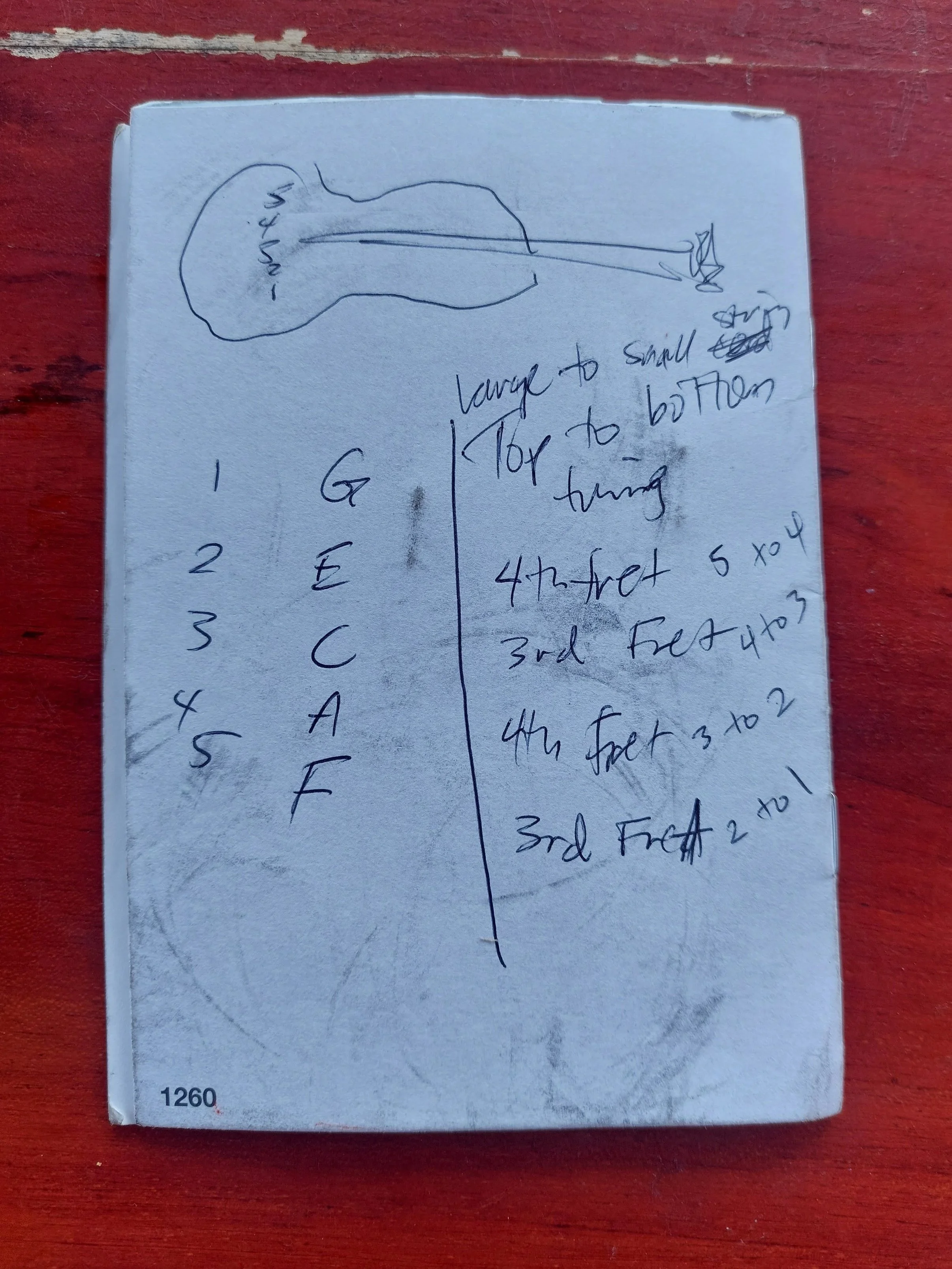
My notes from Chancho.
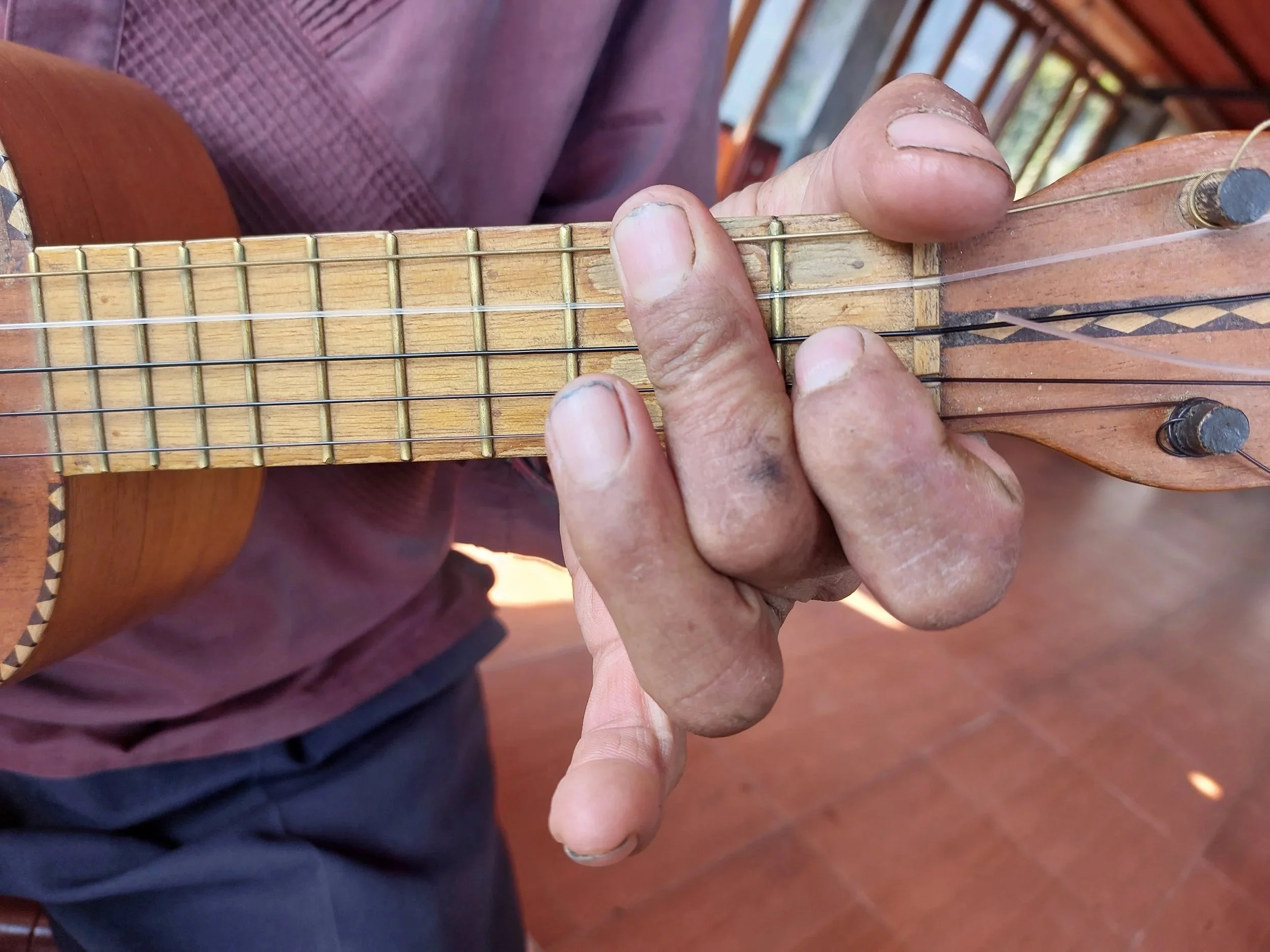
I wasn't convinced his technique was quite ready for weddings and Bar Mitzvas, but he taught me what he could.
I thought we were just three bro's hanging out, telling stories and making jokes, but Chancho looked a bit itchy. No matter what subject we talked about, he kept circling back to the topic of money.
Chancho asked to confirm the price we had agreed on. He was curious if I had the money on me. He wanted to know if it was in dollars or pesos. He went on and on.
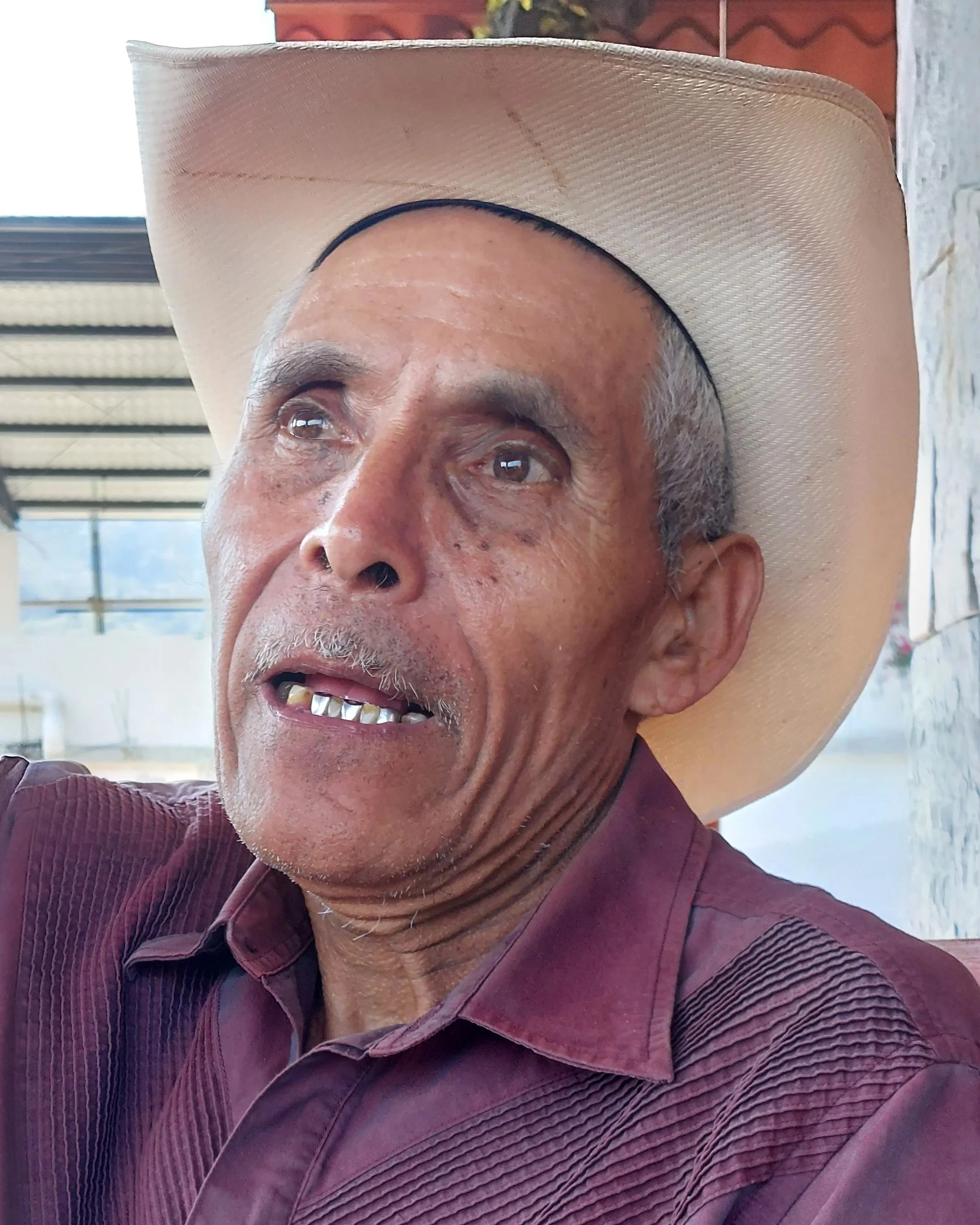
That grill looking shiny.
Trying to settle his nerves, I counted out the cash and put it on the table. We were in the middle of a meal so it would have been rude to grab for it, but Chancho's eyes lit up and a slightly-drunken toothless smile came across his face.
Seeing the cash didn't calm down the money issue like I had hoped. Instead it amped everything up as Chancho got even more excited to get his hands on it.
His demeanor of shy courtesy among guests was fading, as Chancho slammed his beer and ordered another round on our bill without asking.
With the money he was getting paid, we had assumed that he might fix the porch or get a new chair for señora Teresa. Perhaps he would buy a piñata for his great grandson's first birthday.
However, when Rusty asked what he would do with the cash, Chancho said (and I'm paraphrasing here), "Bitches and blow. Yeah boyeeee."
I leaned over to Rusty and whispered, "Huh. Didn't see that coming."
Once I finally handed Chancho the money, he flashed a shyttt-eating grin as wide as his cheeks would spread. From the two inch gap where his pearly whites used to be, I felt he should be hoisting the Stanley Cup over his head.
His appetite for conversation faded and he looked towards the door. There was a little bounce in his shoulders, in time with some imaginary reggaton rhythm in his head.
Chancho didn't want to share the wealth or do the right thing. He wanted to party.
He was done with the boring old past. "Elotes" is just a fancy name for spiced gdddamnnnned corn and he hadn't gotten a leg over on señora Teresa in months. Chancho wanted steak. He wanted to get fkkkkdd up and smash.
One would think he might have some sentimentality about leaving the poor old Padre's Jarana Huasteca behind. Instead he stood up from the table with a look on his face that said, "Meow motherfkkkr. Suck it Father Steve."
After a sloppy, un-satisfying handshake that half-missed my palm altogether, Chancho was gone. Rusty and I stayed at the restaurant a few beers longer processing the one-eighty degree turn in character we had just witnessed. I've never seen someone flip the switch so fast, from quiet villager to frat boy party-starter.
Rusty chuckled about how he would be blackout drunk within an hour. Hell, we were all half in the bag before he left. Two hours later he'd be crunkin' to Daddy Yankee "Gasolina" with a fifth of tequila in each hand. By the time it was dark he would be passed out on the street, breathing heavily with his head on the curb. I'm thinking he has empty pockets, lipstick on his collar and a trail of urine trickling out the bottom of his pant leg. In the morning Teresa throws him out. Now he's homeless and broke. But have no fear - since we bought his Jarana guitar he no longer has any way to earn a living.
Poor Chancho.
Later as we walked back to the hotel quite drunk ourselves, we worked on the idea for our band. Rusty gave us the name "Las Águilas Rosadas" (The Pink Eagles).
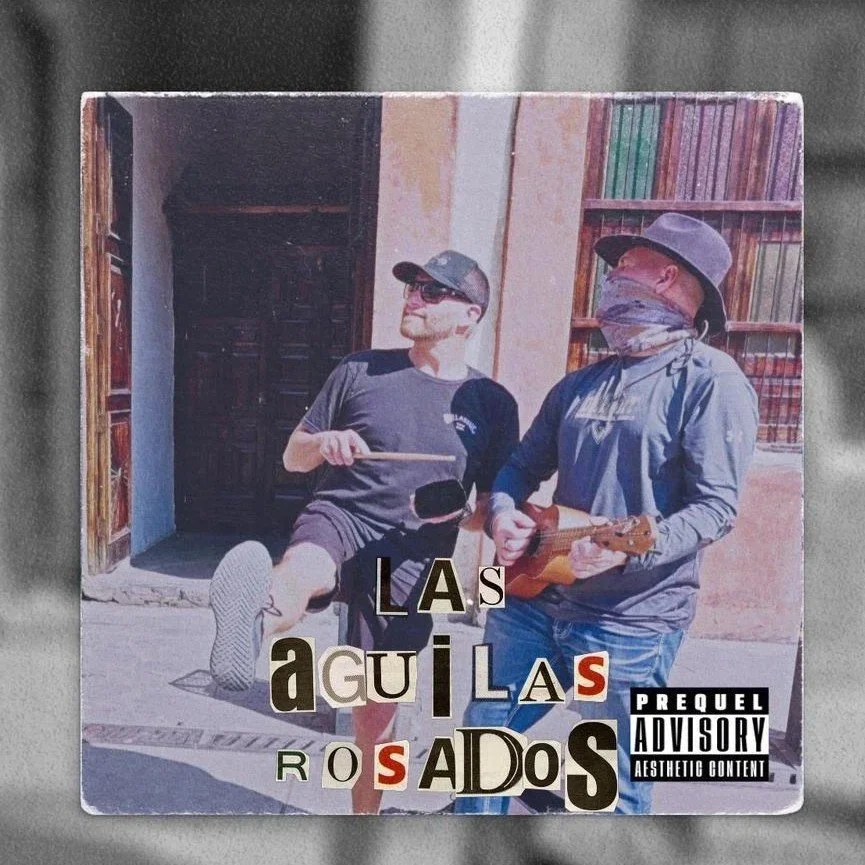
Tour dates coming soon!
As I headed to bed I was feeling very accomplished. The new band had a name and an album cover. We had bought two switchblades, a mini Mexi guitar and a cowbell.
That's a good day.
We kept an eye out for Chancho over the weekend, but didn't see him anywhere. Laughing between us once in a while, we speculated he was still hung over.
By day three I got a little worried. I wondered if Chancho could handle such a big pile of money. An old man with a fistful of pesos can be an easy mark. The walls have eyes in small-town Xilitla and I didn't think Chancho's situational awareness was all that sharp.
Trying to be funny, I said to Rusty, "Oh no. I hope Chancho's not dead by now."
Though I was joking at the beginning of the sentence, I was serious by the end of it. My smile dropped and I got sad for a moment.
Alcohol or drugs could easily finish off a frail old gent, so close to the edge already. Maybe a friend betrayed him or an opportunistic mugger bashed him over the head for the cash. If someone disrespected him at the bar, he might throw a feeble punch. I could see him getting into a fight that he would never win. Perhaps Señora Teresa's brothers went after him for disgracing the family by hooking up some cute little local Toxica.
Maybe he just fell and hit his head.
Sick to my stomach, that is when I first thought, "Damn. I wonder who killed Chancho?"
I held out hope we would run into him in the town square for reassurance he was not dead. Unfortunately, we never saw him again.
A few nights later I woke up with a jolt, flinging myself ninety degrees upright at the waist. In my nightmare, Chancho's lifeless, bloodshot eyes leered at me with the cold stare of death. I was certain that he was gone.
In a plea of desperation, I hollered into the dark, "Who killed Chancho?"
Then, sitting there in bead with my back straight and eyes wide open, I froze in place.
Wait.
We took away his livelihood.
We gave him too much money.
We got him drunk at the restaurant.
We sent him stumbling into the streets.
Suddenly I realized the saddest thing of all. It was never the question that haunted me. It was the answer.
"Who killed Chancho?"
"We killed Chancho."
POST SCRIPT:
Ok, so like I said at the beginning, I'm sure Chancho was just fine. The truth of this story is that Rusty and I hung out for a few hours with a small town alcoholic and bought his guitar. We had fun with the guy and he enjoyed himself as well.
The "Embellished Tragedy and Farcical Gran Lamento of Who Killed Chancho" is mostly just made-up nonsense from a few drunken afternoons. But once we write the music for it, it's going to be one hell of a hit single on the debut album for Las Águilas Rosadas.
(rage)
NEXT POST COMING SOON: Dec 18, 2025
